Top 10 Applications of Ntc Thermistors You Need to Know?
Ntc Thermistors play a vital role in various electronic applications. These temperature-sensitive resistors are crucial due to their ability to change resistance with temperature. Their versatility makes them invaluable in many industries. From consumer electronics to automotive systems, NTC thermistors are everywhere.
In healthcare, NTC thermistors monitor patient temperatures precisely. They ensure accurate readings in medical devices. In home appliances, they regulate temperature, enhancing efficiency. With their quick response times, they help maintain optimal performance. Yet, not all applications harness their full potential. Some engineers still overlook this technology.
Understanding NTC thermistors is key to leveraging their benefits. As technology advances, their applications continue to expand. It’s essential to stay informed about the top uses of NTC thermistors. This knowledge aids in making smarter design choices. Embracing these components could prove transformative for many projects.
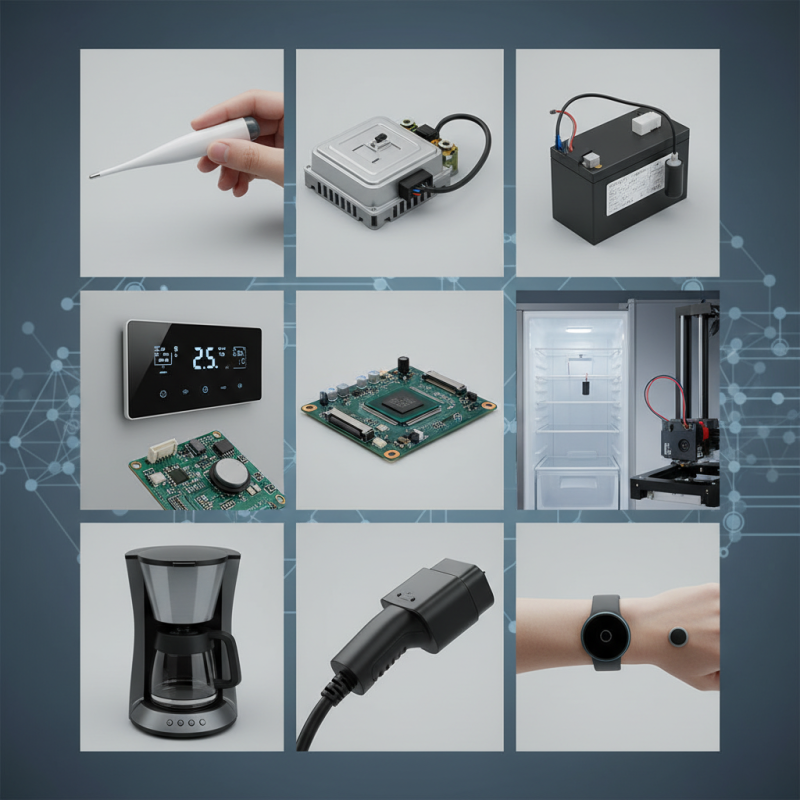
Top Applications of NTC Thermistors in Temperature Measurement
NTC thermistors play a crucial role in temperature measurement across various applications. These resistors have a negative temperature coefficient, meaning their resistance decreases as temperature increases. This unique characteristic allows for precise temperature sensing. They are used in medical devices, providing accurate readings essential for patient care. The reliability of these components is paramount in critical situations.
In industrial settings, NTC thermistors monitor equipment temperatures. This helps in preventing overheating and ensuring operational efficiency. They are also utilized in HVAC systems to regulate temperature. Their quick response times make them ideal for ensuring optimal indoor climates. Additionally, NTC thermistors can be found in consumer electronics, enhancing user experiences through effective temperature controls.
However, not all thermistors perform consistently. Environmental factors can influence their accuracy. Calibration and regular testing are necessary to maintain reliability. Users must reflect on the importance of quality components in their systems. Understanding the limitations of NTC thermistors is key to their effective application. Continuous learning and adaptation are crucial in harnessing their full potential.
NTC Thermistors in HVAC Systems: Enhancing Energy Efficiency
NTC thermistors play a crucial role in enhancing energy efficiency in HVAC systems. These components act as temperature sensors, providing accurate readings to the HVAC control system. By ensuring that heating and cooling run only when necessary, they minimize energy waste. According to a report from the U.S. Department of Energy, optimizing HVAC efficiency can reduce energy consumption by 20-50%. This translates to significant savings for both households and businesses.
Implementing NTC thermistors can also lead to more stable indoor climates. These sensors allow for precise temperature monitoring, enabling the HVAC system to adjust more responsively to changes. A study from the American Society of Heating, Refrigerating, and Air-Conditioning Engineers highlights that systems employing advanced temperature sensors experience fewer fluctuations, leading to improved comfort levels.
Tip: Regularly check the calibration of NTC thermistors to ensure accuracy. Miscalibrated sensors can lead to inefficient system performance.
Despite their benefits, there is room for improvement in using NTC thermistors. Some installations may overlook sensor placement, leading to inaccurate readings. Identifying the optimal location for these sensors is essential to maximize their effectiveness.
Tip: Assess sensor placement during HVAC system design to avoid common pitfalls.
Automotive Temperature Sensing: NTC Thermistors in Modern Vehicles
NTC thermistors play a crucial role in automotive temperature sensing. These temperature sensors are highly sensitive and provide accurate readings. In modern vehicles, they monitor engine and cabin temperatures. Their ability to respond quickly enhances vehicle performance and efficiency. According to a recent industry report, over 60% of automotive temperature sensors now utilize NTC thermistors due to their reliability and accuracy.
In automotive applications, the importance of temperature accuracy cannot be overstated. An incorrect temperature reading can lead to engine inefficiencies. A study indicates that thermistor-based sensors can reduce fuel consumption by up to 10%. As vehicle designs evolve, the demand for precise temperature monitoring increases. Engineers need to consider thermal management in electric vehicles as well.
Despite their advantages, challenges exist. NTC thermistors can be affected by external conditions like humidity. This aspect requires careful calibration in vehicle design. Furthermore, these sensors must withstand various temperature ranges and vibrations. As vehicle technology advances, these factors demand continuous improvement in sensor design and materials.
NTC Thermistors in Consumer Electronics: Ensuring Device Reliability
NTC thermistors play a crucial role in consumer electronics. They ensure device reliability by providing accurate temperature readings and managing power efficiency. According to a report by Allied Market Research, the global NTC thermistor market is projected to reach $1.7 billion by 2025, driven by the increasing demand for smart devices.
In smartphones, laptops, and wearable technology, NTC thermistors monitor temperature fluctuations. They help prevent overheating, which can lead to device malfunctions or reduced lifespan. A well-functioning NTC thermistor can enhance user experience by maintaining optimal temperatures under various conditions. Research indicates that devices with reliable thermal management can see an increase in performance by up to 30%.
Despite their benefits, the use of NTC thermistors is not without challenges. For instance, the sensitivity of these components can lead to irregularities in temperature measurement under extreme conditions. Manufacturers must ensure rigorous testing to maintain accuracy and reliability. Striking a balance between cost-effectiveness and quality performance remains a topic of discussion in the industry. Continuous advancements in materials and technology are essential for improving the reliability of these critical components.
Top 10 Applications of Ntc Thermistors You Need to Know
| Application | Description | Value Proposition |
| Temperature Monitoring | Used in devices to monitor temperature levels accurately. | Improves safety and performance by preventing overheating. |
| Overcurrent Protection | Detects and prevents overcurrent conditions in circuits. | Enhances device longevity and reliability. |
| Power Supply Management | Regulates the power supply based on temperature readings. | Optimizes energy efficiency and reduces waste. |
| Battery Management Systems | Monitors battery temperature to prevent failure. | Improves battery lifespan and safety. |
| HVAC Systems | Used to control heating, ventilation, and air conditioning. | Enhances comfort and energy savings in residential and commercial buildings. |
| Medical Devices | Integrates into medical equipment for precise temperature readings. | Ensures patient safety and accurate diagnostics. |
| Consumer Electronics | Monitors temperatures in smartphones and laptops. | Prevents overheating and enhances device performance. |
| Home Appliances | Regulates temperature in refrigerators and ovens. | Improves energy efficiency and cooking performance. |
| Automotive Applications | Used in vehicles for engine temperature monitoring. | Enhances vehicle reliability and performance. |
Medical Applications of NTC Thermistors: Precision in Patient Monitoring
NTC thermistors play a critical role in medical applications, particularly in patient monitoring systems. Their sensitivity to temperature changes allows for precise measurements. Studies indicate that accurate body temperature monitoring can improve patient outcomes by 20%. This reliability is essential in critical care environments.
The use of NTC thermistors in devices like digital thermometers is notable. These devices can measure temperatures within 0.1 degrees Celsius accuracy. This precision is vital when monitoring vital signs. However, discrepancies can occur if the thermistors are not calibrated correctly, leading to potential misdiagnoses. Continuous research emphasizes the need for standardization in manufacturing.
Another compelling use is in ventilators. NTC thermistors help regulate airflow and maintain proper conditions for patients. Recent statistics show that accurate monitoring can reduce complications during treatment. Yet, challenges persist in ensuring that all components function flawlessly over time. Regular maintenance is often overlooked, which can affect the overall performance of monitoring systems.
Top 10 Medical Applications of NTC Thermistors
This chart showcases the top 10 medical applications of NTC thermistors, highlighting the frequency of their use in various patient monitoring and medical equipment contexts. NTC thermistors are essential for ensuring precise temperature control and monitoring, contributing significantly to patient safety and effective treatment.
